May 25, 2026

The language models powering today's agents are extraordinary. They don't just answer questions, they execute. They return orders, originate loans, process claims, defuse churn, screen candidates, reconcile invoices. The capability ceiling is no longer the model. It is what the model can see at the moment it needs to act.
Give a brilliant analyst the wrong brief and you get a confident, wrong answer. Give them everything at once and they freeze. Models are the same. The central problem in building agents that actually hold up in production is not prompting, not fine-tuning, not even tool design. It is getting the right information to the model at the right time.
Context engineering is the work of deciding what the agent sees, and when.
It helps to look at how this got here.
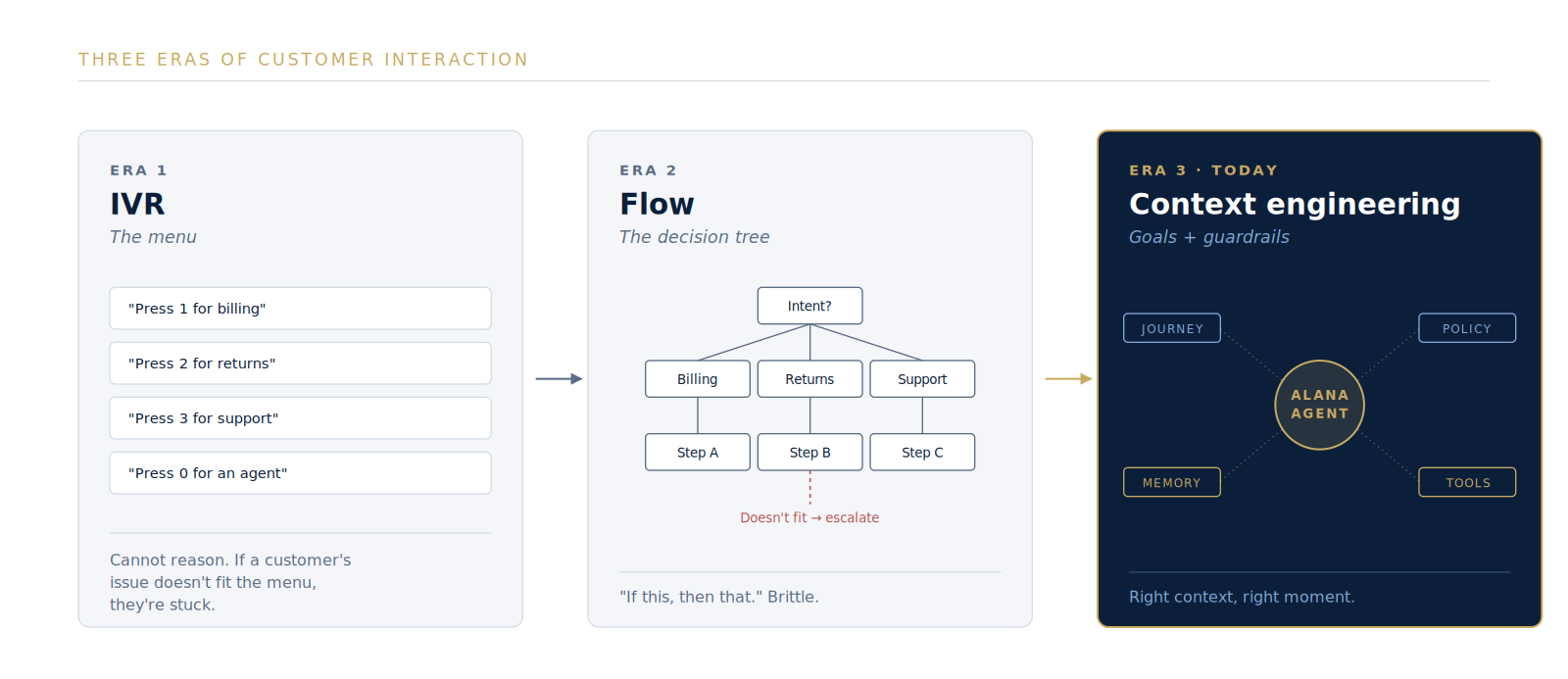
Figure 1, From scripted menus, to brittle flows, to context-driven reasoning.
Era 1, IVR. Press 1 for billing. Press 2 for returns. No reasoning, no flexibility. If the customer's problem doesn't match the menu, they hit the wall, and the call lands on a human queue.
Era 2, Flow. Most enterprise AI agents in production today still live here. The interface improved, customers can speak naturally, but underneath, the system is a flowchart. A digitised SOP. If-this-then-that, branching forever. It works for the cases you planned for. The moment a customer takes the conversation somewhere the flow doesn't anticipate, the agent escalates or fails. And as every new use case bolts on another branch, the graph becomes impossible to maintain.
Era 3, Context engineering. The best agents in production now aren't flowcharts at all. They are reasoning systems guided by goals and bounded by guardrails. The model drives the conversation. The platform's job is to deliver exactly the context the model needs, at the moment it needs it, and nothing more. That's what we build at Alana.
There's a tempting failure mode in agent design: throw everything in. Every SOP, every product detail, every edge-case policy, every escalation matrix, all loaded into the system prompt, every turn.
It feels safe. It is anything but.
As context grows, model attention degrades. This isn't a quirk, it's measurable, repeatable, and gets worse the more capable the model becomes at long-context tasks in benchmarks. Real conversations are not benchmarks. Every irrelevant token in the window is a token competing with the one that actually matters. By the time the agent reaches the moment of decision, the signal is buried under policy boilerplate the customer was never going to need.
The answer is progressive disclosure. Start with the minimum. Reveal more only when the conversation justifies it.
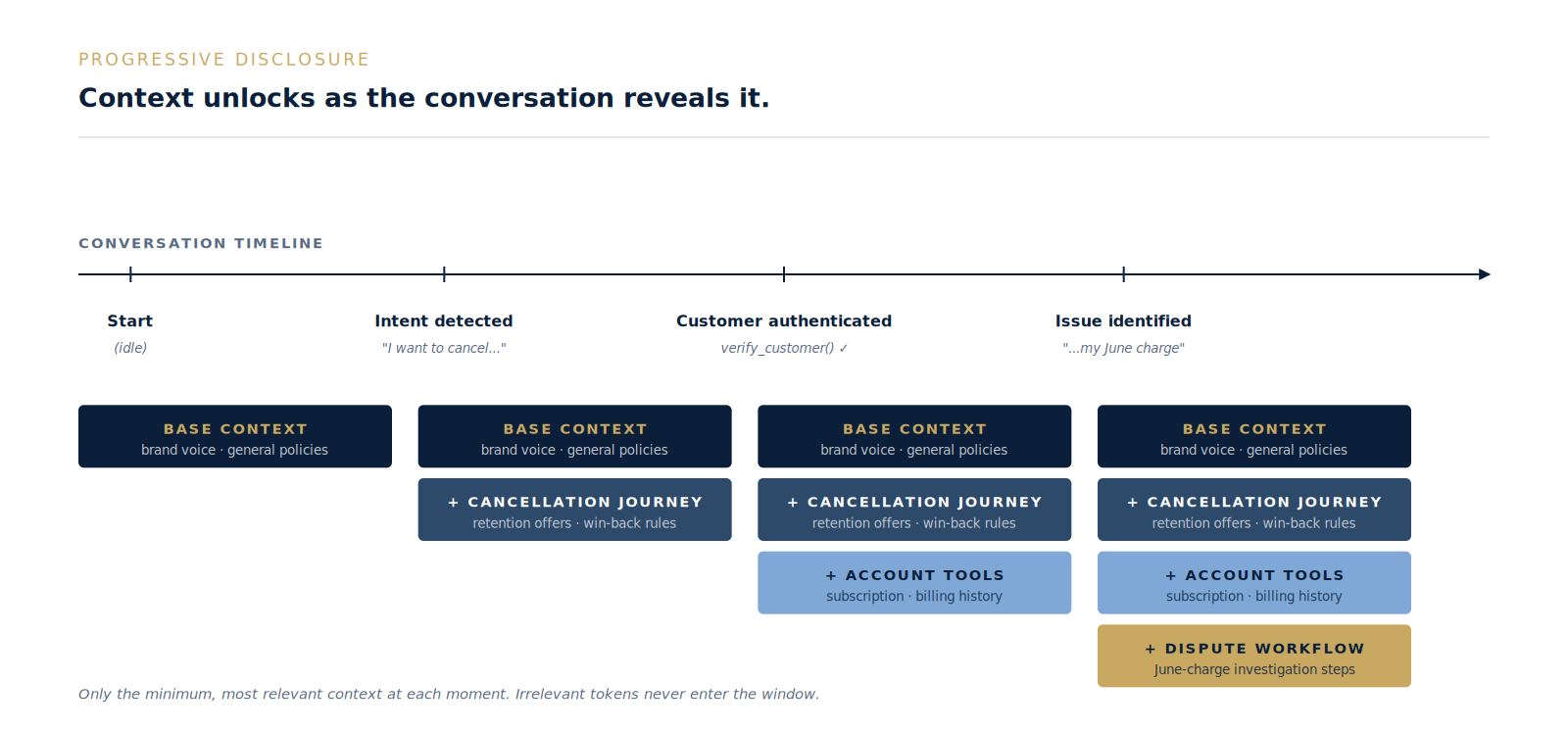
Figure 2, Context accumulates as the conversation surfaces what's relevant.
A customer calls in. At that moment the agent doesn't need the international shipping schedule for Germany, the dispute resolution policy for high-value transactions, or the cancellation retention script. It needs brand voice, basic identification tools, and a sense of how to triage.
Then the customer says: "I want to cancel." Now the cancellation journey enters the window, retention logic, alternative offers, win-back rules. Once they authenticate, account-specific tools come online. Once they mention a specific charge, the dispute workflow loads with the exact policies needed to investigate that transaction.
Each step unlocks exactly what's needed for the next. Nothing earlier. Nothing extra.
Progressive disclosure only works if you can specify what 'when' means. That's the role of conditions.
Every piece of context in an Alana agent, every journey, tool, policy, knowledge base, is paired with a condition that answers a single question: under what circumstances does this become relevant?
Conditions fire on two kinds of signals:
When a condition is met, the block enters the window. When the condition no longer holds, the block can leave. The agent's context isn't a fixed prompt, it's a living composition that evolves with the conversation.
Under the hood, we represent an agent as a set of composable context blocks. Each is independent. Each is gated. Each can be authored, versioned, and audited on its own.
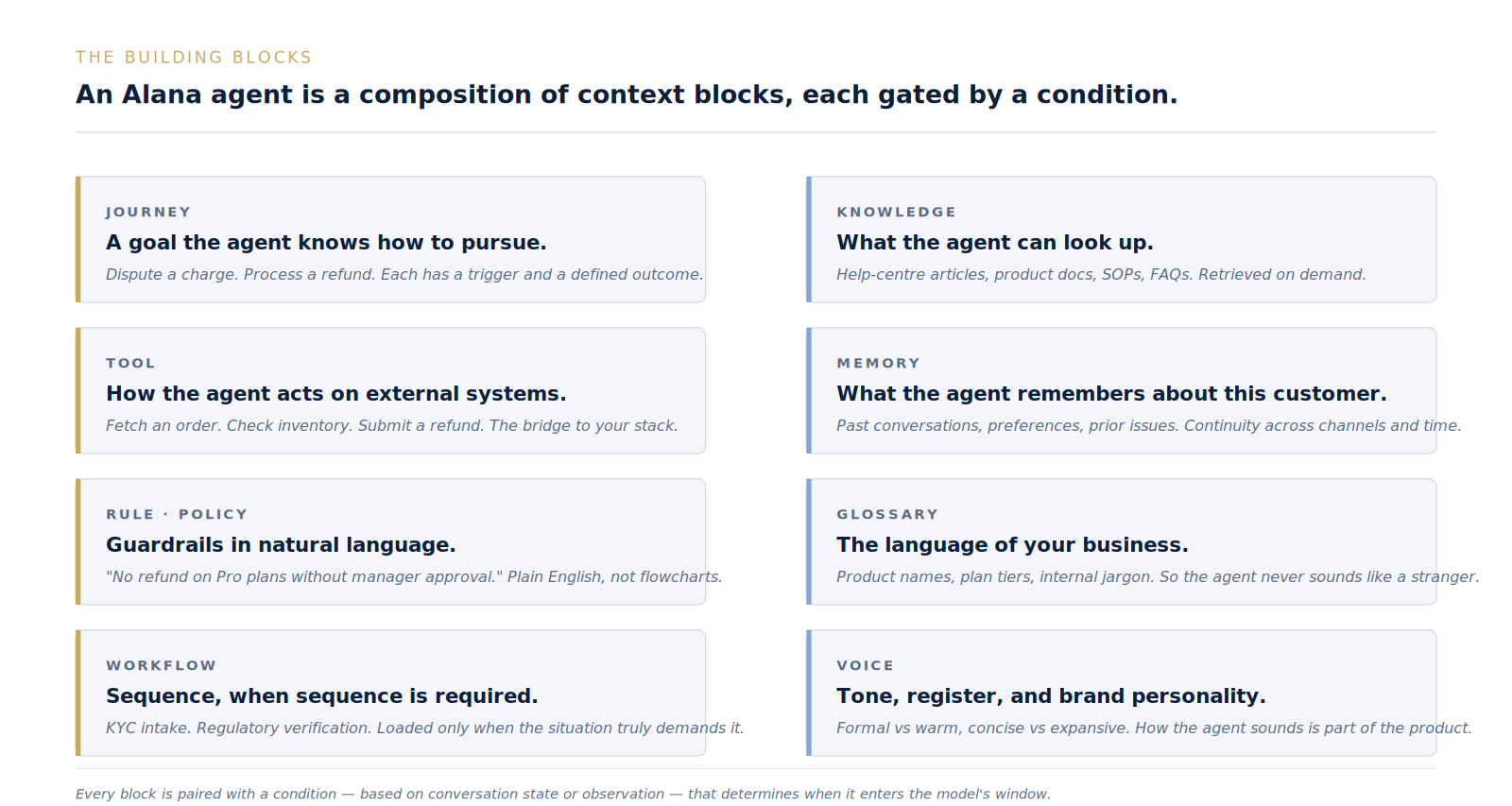
Figure 3, The eight block types we use to compose an Alana agent.
A note on workflows. We just argued that rigid flows are limiting. But some situations genuinely require sequence, regulated intake, KYC, multi-step verification where the order of operations is the compliance requirement. The difference between the old way and the new is that workflows are no longer the organising paradigm. They're one block among many, loaded only when the situation calls for them.
With one journey and a handful of tools, any modern frontier model will perform reliably. You can hard-code, prompt-stuff, or hand-wave, and it mostly works.
At production scale, those shortcuts break.
An agent handling five use cases for one segment can get away with loose context management. An agent handling fifty use cases across a dozen customer segments, three regulatory regimes, two languages, and five integrated systems cannot. Every piece of context has to arrive at exactly the right moment, or the model gets overwhelmed and the experience degrades, slowly at first, then everywhere at once.
An agent that can handle 5 journeys can be sloppy. An agent that handles 50 cannot.
Context engineering solves this at an architectural level. Fewer, more relevant tokens means lower hallucination, more natural conversation, faster responses, and lower inference cost. You aren't paying to process a thousand tokens of baggage policy during a simple flight rebooking.
More importantly, it future-proofs the agent. When you hard-code logic into flows, you constrain the model, it can only be as capable as the paths you predefined. With context engineering, the agent reasons freely within its guardrails. As more capable models are released, and they will be, every quarter, your agent inherits the improvement without rebuilding.
A smarter model doesn't remove the need for context engineering. Even the smartest people can't know what they haven't been told. But a smarter model amplifies the payoff for doing it right.
Alana's platform was designed around context engineering from the start. We don't think of an agent as a prompt, we think of it as a composition of context blocks, conditions, and guardrails, layered on a sovereign model the client controls.
For enterprise customers in regulated industries, banking, retail, recruiting, telecoms, that last part matters. Sovereign deployment means the model, the context, and the customer data live where the client's compliance team says they have to live. The architecture works the same way regardless.
In practice, this is how our customers ship:
No matter how the agent is built, it works the same way underneath. The same context engineering. The same auditability. The same behaviour.
Context engineering is the work of building great agents. Everything else is detail.
WORK WITH ALANA
Alana AI builds production-grade, sovereign AI agents for enterprise customer service, general operational efficiency. We work with banks, retailers, recruiters, and consumer brands who need agents that hold up at scale, and who can't compromise on data residency, control, or trust.
If you're building one, or rebuilding one, talk to us!


